Schluter JOLLY Aluminum Tile Edging Trim - 3/8" Matte Black (MGS)
Schluter JOLLY is a versatile aluminum tile edging profile that protects exposed tile edges while creating a clean, decorative finish on walls, backsplashes, and other tiled surfaces.
Schluter JOLLY Aluminum Tile Edge Trim: Wall and Corner Protection
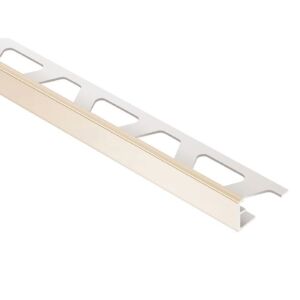
Schluter JOLLY is a finishing and edge protection profile designed for the outside corners and exposed edges of tiled wall surfaces. Its trapezoid-perforated anchoring leg is secured in the mortar bond coat beneath the tile, while the vertical section provides a clean decorative finish and protects adjacent tile edges.
The integrated joint spacer creates a defined joint cavity between the tile and profile, helping achieve a consistent and professional appearance. The profile is suitable for a wide range of tile and grout combinations and can also be used to create decorative transitions with natural stone and other compatible wall coverings.
JOLLY is particularly well suited for the top edge of tiled walls, backsplashes, bathtub surrounds, and other areas where exposed tile edges require both protection and an attractive finished appearance.
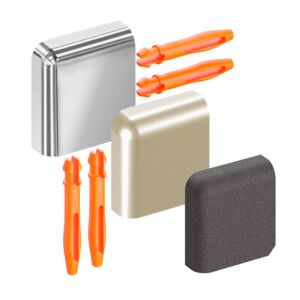
The radius-perforated anchoring leg allows JOLLY to be formed around curves, expanding its versatility for more complex installations. Matching outside corners and connector pins are also available for clean profile connections.
Key Features and Benefits
- Tile Edge Protection
Helps prevent exposed tile edges from chipping and damage while providing a durable finished edge - Clean Decorative Finish
Creates a sleek transition along tiled walls and complements a wide range of tile and grout styles - Integrated Joint Spacer
Establishes a consistent joint cavity between the tile and profile for a neat, professional installation - 90° Vertical Profile
Provides a clean 90° finish at outside corners and along exposed tile edges - Versatile Applications
Ideal for wall tile, backsplashes, bathtub surrounds, and the top edges of tiled walls - Curve-Friendly Design
The radius-perforated anchoring leg allows the profile to be used for curved installations - Matching Accessories
Matching outside corners and connector pins are available for completing professional installations
Schluter Edging Trim Installation
- Select the profile according to tile thickness and format.
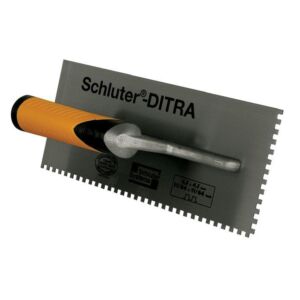
- Using a notched trowel, apply thin-set mortar to the area where the profile is to be placed. If the JOLLY, QUADEC, RONDEC, RONDEC-DB, DECO-DE, FINEC, or FINECSQ profile is to be used as edging for an outside wall corner, finish tiling one wall first; then trowel thin-set mortar over the corner area of the second wall.
- Press the perforated anchoring leg of the profile into the mortar and align.
- Trowel additional thin-set mortar over the perforated anchoring leg to ensure full coverage and support of the tile edges.
- Solidly embed the tiles so that the tiled surface is flush with the top of the profile; the profile should not be higher than the tiled surface, but rather up to approx. 1/32" (1 mm) lower.
- Set the tile to the integrated joint spacer, which ensures a uniform joint of 1/16" - 1/8" (1.5 - 3 mm). With the stainless steel profiles, leave a space of approximately 1/16" - 1/8" (1.5 - 3 mm).
- Fill the joint completely with grout or setting material.
- Work with materials and tools that will not scratch or damage sensitive surfaces. Setting materials must be removed immediately, especially from aluminum.
Note: Matching corners and connectors are available. Corners are held in place with thin-set mortar. Fill the ends of the profile with thin-set mortar prior to inserting the accessories. Connectors are held in place with a friction fit. Insert the connector into the profile approximately half the length of the connector piece and connect the adjacent profile.
How do I cut profiles?
Schluter profiles are available in a variety of different materials , so methods for cutting vary. Below are best practices for cutting according to material type.
Plastic
Plastic profiles may be cut using Schluter SNIPS or similar. It is important to make sure the blade is sharp in order to ensure a clean cut.
Aluminum
One option for cutting aluminum profiles is to simply use a hacksaw. Look for a bimetal blade and select the highest teeth per inch, or TPI, available. A miter box is recommended to help ensure a straight cut. Aluminum profiles may also be cut using a variable-speed angle grinder with the Schluter PROCUT-TSM cutting wheel. Set the angle grinder to the lowest speed. A clamp or cutting jig can be used to secure the profile and help ensure a straight, clean cut. Finally, aluminum profiles can also be cut using a chop saw or miter saw with a non-ferrous blade. After cutting, make sure to remove any burs with a file before installation.
Brass
Brass profiles can be cut by using a hacksaw with a bimetal blade with the highest teeth per inch available, or by using a chop saw or miter saw with a non-ferrous blade. Removing any burrs from the cut end of the profile with a file (or similar) is also recommended.
Stainless Steel
The simplest option for cutting stainless steel is to use a variable-speed angle grinder with the Schluter PROCUT-TSM cutting wheel. Set the angle grinder to the lowest speed. Another option for cutting stainless steel profiles is to use a band saw with a metal cutting blade. After cutting, make sure to remove any burs with a file before installation.
| SKU | S J 100MGS |
|---|---|
| Weight (lbs.) | 0.42 |
| Non-Returnable | No |
| Manufacturer | Schluter |
| Dimensions (L x W x H) | 8' 2-1/2" x 1 1/16" x 19/64" |
| Trim Material | Aluminum |
| Trim Length | 8' 2-1/2" |